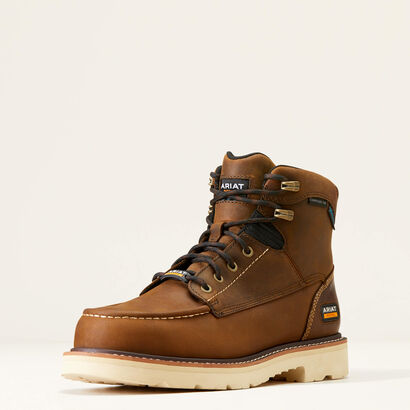
Best Work Boots for the Money: Long-Term Value
The best work boots for the money balance job-ready performance with a practical plan for long-term ownership. The boots below are ranked by customer review ratings, giving you a starting point for comparison. Start with the conditions you work in and the requirements your footwear needs to meet. Then weigh the current purchase cost against construction, comfort and upkeep needs. For repair-minded shoppers, documented resoleability deserves a close look. Check the exact boot rather than assuming every style in a family shares the same construction. Repairable construction can factor into your decision, but it does not guarantee the lowest ownership cost. A lower-upfront-cost pair can also make sense when it meets your work requirements. Compare pull-on convenience with lace-up adjustability, and consider the surfaces you cover throughout a shift. Choose for the work ahead, with maintenance, potential repairs and eventual replacement in view.
Read More
What to Look for in Work Boots for the Money
Compare these four factors to find work boots that fit both your job and your ownership budget.
1. Jobsite Requirements
2. Documented Repairability
3. Purchase and Replacement Costs
4. Comfort and Practical Upkeep
Best Work Boots for the Money: Long-Term Value
FAQ
No. Resoleability depends on the exact boot’s construction and its condition when repair is needed. Look for explicit documentation for the style, then have a qualified repair professional assess it rather than relying on visible stitching alone.
Goodyear-welt construction uses a welt—a strip of material—as part of the connection between the upper and sole assembly. It is a construction method worth checking when comparing repair options, but it is not a blanket promise that every boot can be resoled in every condition.
Pull-on work boots use an open shaft or elastic-sided entry rather than a laced closure. Lace-up boots let you adjust the closure along the instep and shaft. Compare the everyday handling you prefer separately from the boot’s documented construction and care requirements.
Follow the boot’s care instructions, remove loose dirt and use cleaning and conditioning products intended for its leather finish. Test any treatment in an inconspicuous area first. Suede, nubuck and textile panels may require a different care routine.
Save the style name or number, construction details, care instructions and any model-specific repair guidance. Record previous repairs and treatments as well. Bring that information with the boots when requesting a repair assessment.