
November 3, 2025
Submitted by: Ariat International, Inc.
I. Introduction
Human trafficking, modern slavery, child labor and forced labor are practices generally used as a way of maximizing profits, by producing goods and/or providing services, often at lower costs, through the exploitation of individuals. These practices, defined differently across jurisdictions, often disregard individual rights and result in severe exploitation. The 2021 International Labor Organization (ILO) estimates suggest that 28 million people were trapped in forced labor globally, generating $236 billion USD in illegal profits every year.1 At the same time, freeing people from forced labor and bringing them into formal employment could generate $611 billion USD in global gross domestic product.2 There is a clear role for businesses in preventing, identifying, and responding effectively to the risks of exploitation in their operations and supply chains.
The United Kingdom (UK), Australian and Canadian governments have legislation in force aimed at combatting modern slavery in supply chains:
This document conforms to the International Reporting on Modern Slavery, Forced Labour, and Child Labour guidance (published July 2025) and constitutes the Annual Report (the “Report”) pursuant to the Canada, Australia, and United Kingdom regulations referenced above. This report is filed on behalf of Ariat International, Inc. and its subsidiaries (“Ariat”) covering the 2025 Fiscal Year (July 1, 2024- June 30, 2025). It outlines the actions taken by Ariat to address the risks of modern slavery3, forced labor, and child labor in its supply chains, as required by the laws implemented in Canada, Australia, and the United Kingdom. Ariat is therefore publishing the details of the steps it has taken in its fiscal year to ensure that modern slavery is not taking place in its supply chains.
1 ILO, 2024: Profits and poverty: The economics of forced labour
2 ILO, 2024: Acting against forced labour: An assessment of investment requirements and economic benefits
3 As defined in Annex B – Definitions of International Reporting on Modern Slavery, Forced Labour, and Child Labour
II. Our Commitment
Founded in 1993, Ariat is committed to building a different breed of company, one that reflects our core values as a team and those of our consumers. Our company values have shaped our success since 1993 – a commitment to innovation, quality, integrity, teamwork and respect. We believe our values are what set us apart and have helped build Ariat into the one of the top Equestrian, Outdoor and Work brands in the world.
Ariat has always valued the integrity of our supply chain partners, many of whom we have worked with for decades. Our selection process is multifaceted, and in addition to choosing suppliers who provide quality and top-tier products, we also require that our partners treat their employees with respect and are in compliance with the law. Ariat has a zero-tolerance policy in relation to any form of modern slavery. We prohibit our employees, partners, and supply chain from engaging in, suggesting, allowing, or ignoring modern slavery, including forced labor and child labor in the conduct of our business. Ariat is committed to ensuring that we have a fair and safe supply chain. This commitment is implemented through Ariat’s Social Compliance program.
III. Corporate Structure and Business Activities
Ariat is the largest Western and English footwear and apparel brand in the world and one of the fastest-growing work footwear and apparel brands. Ariat has over 7,000 retail locations, 38 Ariat stores, 16 ecommerce channels. Ariat’s team of 1,600 employees is located in offices in the United States, UK, Mexico, and China. Ariat continues to lead the market in designing, developing, and manufacturing the most innovative footwear, apparel, and denim for the world’s top equestrian athletes.
This report is prepared by Ariat International, Inc. a California corporation, on its own behalf and on behalf of the following subsidiaries for the Ariat 2025 Fiscal Year:
- Ariat Europe Ltd (UK)
- Ariat EU BV (Netherlands)
- Ariat Hong Kong Ltd (Hong Kong)
- Ariat (Dongguan) Information Consulting Co., Ltd (China)
Ariat’s headquarters are located at 1500 Alvarado Street, Suite 100, San Leandro CA 94577.
IV. Ariat’s Global Supply Chain
Ariat products are designed in California and developed with our factory partners throughout our global supply chain. Through the commercialization process, Ariat’s development and sourcing teams ensure each factory partner is capable of producing each product. Once a product is commercialized, maintaining product integrity is the responsibility of the quality and sourcing team.
Ariat’s global sourcing team is responsible for streamlining our sourcing practices, developing governance standards, and supporting our overall global sourcing and compliance strategy. We select our supply partners based on their use of industry best practices and our shared values of innovation, quality, integrity, teamwork, and respect.
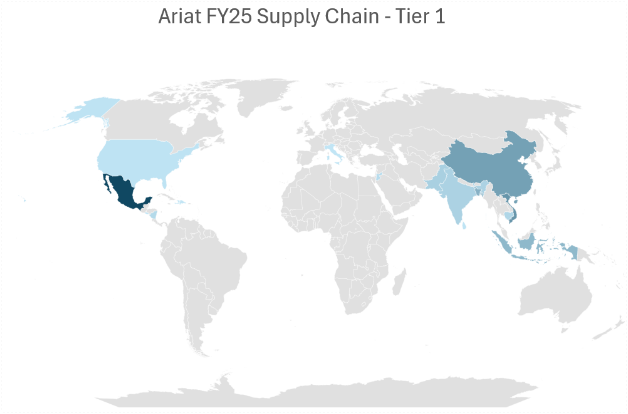
Ariat works with both Tier 1 (finished goods) and Tier 2 (materials) suppliers. Ariat has approximately 65 approved Tier 1 finished goods partners producing apparel, footwear, and accessories. We have nearly 300 approved, nominated Tier 2 material suppliers. The map below illustrates Ariat’s global sourcing partnerships, based on purchase orders placed.
All suppliers undergo a comprehensive onboarding process, which includes, among other things, participation in our Social Compliance Program, and compliance with our Restricted Substances List. Ariat’s Restricted Substances List is based on the recommendations of the Apparel and Footwear International RSL Management (AFIRM) Working Group and is updated annually to ensure that our products comply with current state and federal chemical regulations and industry best practices. Additionally, all Ariat nominated tanneries are required to pursue Leather Working Group Gold certification. The Leather Working Group is the leather industry’s best practice standard for responsible water and energy consumption, restricted substances, and fair labor practices.
Through the onboarding process, all potential partners are made aware of Ariat’s zero tolerance policy on modern slavery, including forced labor and child labor. Potential partners are also alerted to Ariat’s prohibition on unauthorized subcontracting, which aims to ensure visibility of the complete supply chain. Lack of transparency in the footwear and apparel supply chains is a known concern in the industry. Subcontracting and poor record keeping (intentionally or otherwise) creates a risk for forced labor, chemicals management, and other regulatory non-compliance. In addition to Ariat’s social compliance auditing program, in the last fiscal year, Ariat invested in expanding our in-country workforce, to ensure a regular presence in partner facilities. These individuals are tasked to ensure product quality and alert the sourcing team of any real or potential noncompliance, including modern slavery, forced labor, or child labor.
Ariat’s code of conduct and each related policy holds Ariat partners responsible for any noncompliance in the upstream supply chain. We expect our Tier 1 (finished goods) and Tier 2 (nominated material suppliers), to vet their upstream partners and ensure they are working only with responsible companies that comply with Ariat’s social compliance program.
V. Policies and Due Diligence Processes
Ariat’s commitment to ensuring a fair and safe supply chain is implemented through Ariat’s Social Compliance program. The program strategy is aligned cross-functionally with Ariat’s Legal, Product Quality and Compliance, and Sourcing teams. The program is championed by the Director of Compliance. Ariat has established the following relevant policies to address forced labor and child labor and ensure a fair and safe supply chain:
Supplier Code of Conduct.
The foundation of Ariat’s Social Compliance Program is outlined in our Supplier Code of Conduct (see appendix article 1). The Code of Conduct is published in 6 languages and is provided to every prospective partner, with the understanding that compliance to our Code of Conduct is requirement of doing business with Ariat. Amongst other things, it sets out our commitment to honest, ethical, and fair working practices and prohibits the use of child labor, bonded labor, involuntary servitude or forced labor. The code of conduct prohibits unauthorized subcontracting, to ensure better transparency of Ariat’s supply chain.
Ariat partners with a 3rd party auditing body, LRQA (previously Elevate), to evaluate our factories on a bi-annual basis against local regulations, industry best practices, our Supplier Code of Conduct, Forced Labor Prevention Policy and other social impact policies. LRQA audits review factory policies and records related to recruitment, including migrant labor risks, worker contracts, hours, payments, and other social benefits. LRQA auditors observe factory practices and conduct private and semi-private interviews to validate factory policies related to child labor, forced labor, including compulsory overtime, disciplinary actions, grievance mechanisms, collective bargaining, and other worker wellbeing topics. Each LRQA audit includes a facility health and safety check, to identify potential fire, chemical, electrical, structural risks to reduce the risk of unsafe working or living conditions. Audits and interviews are conducted in local language.
Factories to be audited are selected based on potential risk, as defined by the Ariat team and LRQA. Risk criteria include geographical location of the factory, previous audit findings, and any other concerns identified by the Ariat team. The audit schedule is created and managed by the Director of Compliance. Completed LRQA reports are reviewed by the Director of Compliance, who meets with the sourcing and legal teams bi-weekly to discuss findings and mitigation efforts.
Forced Labour Prevention Policy.
All Ariat factories and nominated material suppliers are required to sign our Forced Labor Prevention Policy (see appendix article 2). All partners are required to commit to providing proof of origin documentation for all sourced materials, if a forced labor concern arises. The Forced Labor Prevention Policy requires our supply chain to commit to a complete prohibition of materials or labor from the Xingang region of China.
Conflict Minerals.
Each year Ariat executes a Conflict Minerals Survey which traces conflict minerals sourcing back to the smelter and country. In this survey, we look for areas of risk and, where applicable, follow up to our supply chain partners to ensure that Ariat’s entire supply chain is free of coercion, including the use of child labor.
VI. Remedial Action Taken During FY2025
Ariat’s Social Compliance Program is backstopped by our 3rd party auditing program. Ariat partners with LRQA (previously Elevate) to evaluate our factories on a bi-annual basis against local regulations, industry best practices, our Supplier Code of Conduct, Forced Labor Prevention Policy and other social impact policies. Our risk-based auditing program, which began in May 2021 is under regular review and revised accordingly. We utilize the audit results to train relevant stakeholders on social compliance topics, highlight potential risks (including forced labor or child labor), to mitigate risks through corrective action plans, and to inform sourcing and other business decisions, to ensure a fair and safe supply chain.
LRQA audit reports are consolidated and reviewed by the Director of Compliance, who meets with the appropriate cross-functional teams to discuss findings and develop mitigation efforts, as needed. Depending on the severity of the findings, Ariat may work directly with the factory to resolve or partner with LRQA to conduct a formal Corrective Action Plan (CAP) and Review.
LRQA and Ariat are aligned on maintaining a zero-tolerance on certain audit findings, such as forced labor or bribery. If an audit identifies a zero-tolerance finding, an emergency alert is sent to the Director of Compliance, within 24 hours. The Director of Compliance would then work cross-functionally with Ariat’s Legal and Sourcing teams to determine the appropriate course of action. To date, no Ariat factory has been subject to any remediation or additional training based on our zero-tolerance policy.
In Ariat’s fiscal year 2025, LRQA executed 36 social compliance audits for Ariat. In conjunction with LRQA, Ariat assigned nine factories additional training, which was led by LRQA via remote e-learning webinars. None of the audits resulted in LRQA recommended corrective actions related to forced labor, child labor or modern slavery.
VII. Risks of Modern Slavery in Ariat’s Operations and Supply Chains
As discussed above, none of the corrective actions identified by LRQA involved the use or threat of modern slavery. To the best of our knowledge, we have not identified risks of forced labor and child labor in our operations and supply chains.
VIII. Program Effectiveness and Continuous Improvement
While Ariat has not identified any instances of modern slavery, child labor, or forced labor in our supply chain, these are known risks in the footwear and apparel industry. Ariat remains committed to preventing forced labor and child labor from taking place in our businesses and in our supply chains. We will continue to review our policies, procedures and practices periodically to determine any enhancements we can make to help prevent forced labor and child labor and any other forms of human rights abuse.
Ariat’s continuous improvement commitment is evidenced by the investment in additional in-country resources to increase the brand’s presence and influence with our factory partners. These individuals have given Ariat better visibility into the supply chain, including unauthorized subcontracting and other risks of modern slavery, and enabled Ariat to initiate a greater number of corrective action plans to address social compliance audit findings, compared to prior years.
IX. Conclusion
Ariat understands and accepts the role our business has in preventing, identifying, and responding to risks of exploitation in our business operations and supply chains. We believe we have established a sufficient program to ensure awareness of our social compliance expectations, including the prohibition of all forms of modern slavery, forced labor, and child labor. We remain committed to studying industry best practices and to seek advice from 3rd party experts, to continue to evolve our program to ensure our fair and safe supply chain.
X. Approval
In accordance with the requirements of Canada’s Fighting Against Forced Labour and Child Labour in Supply Chains Act (S.C. 2023, c.9), the United Kingdom’s Modern Slavery Act (2015), and Australia’s Modern Slavery Act (2018), I attest that I have reviewed the information contained in the report for the entity or entities listed above. Based on my knowledge, and having exercised reasonable diligence, I attest that the information in the report is true, accurate and complete in all material respects for the purposes of the Act, for the reporting year listed above.
Pankaj Gupta
Chief Financial Officer / Chief Operating Officer
Ariat International, Inc.
January 15, 2026
Signed on behalf of the Board of Directors of Ariat International, Inc.
I have the authority to bind Ariat International, Inc.
Appendix -
Article 1 – Ariat Supplier Code of Conduct v 01152026
ARIAT INTERNATIONAL, INC.
SUPPLIER CODE OF CONDUCT
Ariat International, Inc. (“Ariat”) embraces a corporate culture steeped in the values of integrity, commitment, honesty, and fairness, treating others with respect and appreciation. We are committed to conducting business in accordance with high ethical and legal standards, and we work only with suppliers that share this commitment. As Ariat expands its presence throughout the world we insist that those we do business with meet these same standards and ethical practices associated with our heritage. Ariat suppliers will be chosen based on their sharing in our approach and values so as not to compromise the expectations of our brand and customers.
Ariat has developed this Supplier Code of Conduct (“Code”) to reflect the Ariat culture, define the standards by which Ariat will hold our suppliers, distributors, vendors, and facilities that produce products for Ariat or any of its subsidiaries, divisions, or affiliates (each a “Supplier” and collectively “Suppliers”) responsible and to clearly communicate our expectations to the partners in our supply chain. This Code establishes the minimum standards that apply to and must be met by all Suppliers. If there is a difference between a relevant legal requirement and this Code, the more stringent standard shall apply.
Supplier understands that a failure to comply or have practices in place to correct noncompliance with this Code may lead to suspension or termination of Ariat’s business relationship with the Supplier. In all instances, Ariat reserves the right to decline to take any action it reasonably believes will cause Ariat to violate any law. Ariat reserves the right to modify this Code at any time.
Legal Compliance
All Suppliers must operate in full compliance with all applicable laws, regulations, rules, and local legal requirements relevant to the conduct of their business. Suppliers are expected to promptly report to Ariat any actual or suspected violations of the law or this Code.
Management Oversight
Each Supplier shall designate management and supervisory personnel with responsibility for ensuring ongoing compliance with the requirements set forth in this Code.
Ethical Business, Anti-Corruption & Conflicts of Interest
Ariat expects all Suppliers to maintain the highest ethical standards and conduct business in a transparent and trustworthy manner. All Suppliers shall comply with all applicable anti bribery and anti-corruption laws (including the U.S. FCPA and U.K. Bribery Act). Suppliers shall not offer, provide, request or accept bribes, kickbacks, facilitation payments, or anything of value intended to obtain or retain an improper advantage or personal benefit. Gifts, hospitality or other benefits connected to Ariat business must be modest, lawful, accurately recorded, and pre-approved where required. No gifts, hospitality or other benefits shall be provided to any government officials in connection with Ariat business. Supplier shall conduct risk based due diligence and ensure its agents/sub-suppliers adhere to these obligations. Supplier shall avoid any activities that would cause a conflict of interest or appear to cause a conflict of interest when dealing with Ariat employees.
Suppliers must keep accurate books and records and must never submit falsified records to Ariat.
Competition, Fair Dealing, and Brand Protection
Ariat expects that a Supplier will conduct its business in a manner that promotes fair dealing in compliance with applicable antitrust laws. Suppliers should strive to prevent and avoid situations which may adversely affect Ariat’s business interest or brand reputation. Any illegal activities (such as counterfeiting, diversion and other intellectual property rights violations) are prohibited.
Human Trafficking & Slavery (Forced Labor)
All labor must be voluntary. Suppliers and their supply chain must not support or engage in slavery or human trafficking in any part of its supply chain. Without limiting any supplier obligations hereunder, Ariat suppliers shall not, and shall ensure that its partners do not, support or engage in, or require any:
- Compelled, involuntary, or forced labor, including but not limited to labor that might be required as a means of political coercion or as punishment for peacefully expressing political views;
- Labor to be performed by children;
- Bonded labor;
- Indentured labor; and
- Prison labor.
Child Labor / Young Workers
The use of child labor is strictly prohibited. Suppliers must not employ any person under the age of 16 years or any person who is younger than the age for completing compulsory education in the country of manufacture where such an age is greater than 16 years. Suppliers must observe all legal requirements for work of authorized minors, including those related to hours of work, wages, minimum education, work type, and working conditions. Suppliers must maintain documentation of each worker’s date of birth.
Foreign Migrant Labor
Suppliers must ensure any migrant labor is authorized by host and home country and all local laws and regulations are obeyed. Suppliers must ensure local and foreign workers are treated on an equal basis and none is subject to any form of forced, compulsory, bonded or indentured labor.
Identification Papers
Supplier shall not require any worker to surrender control over: original identification papers or documents giving a foreign worker the right to work in the country, identification papers or documents, such as a passport, giving a foreign worker the right to enter or leave the country; or documents, such as a birth certificate, evidencing the worker's age.
Financial Obligations
Supplier shall not, whether or not as a condition to the right to work, require any worker (or worker's spouse or family member) to, directly or indirectly, pay recruitment or other fees or other amounts (monetary or in-kind), incur debt, make financial guarantees, or incur any other financial obligation.
Freedom of Movement
Supplier shall ensure that workers have the right to freedom of movement without: delay or hindrance; or the threat or imposition of any discipline, penalty, retaliation, or fine or other monetary obligation. Worker freedom of movement rights include each worker's right to leave the facilities without retaliation at the end of each workday, based on reasonable health and safety-related justifications, and based on any reasonable circumstances, such as personal or family emergencies.
Freedom to Terminate Employment
Supplier shall allow workers to terminate their employment or work arrangement without restriction and without the threat or imposition of any discipline, penalty, retaliation, or fine or other monetary obligation.
Non-Discrimination
Discrimination in any form is prohibited. Supplier shall not discriminate in hiring, compensation, training, advancement or promotion, termination, retirement, or any other employment practice based on race, gender, gender identity, national origin, sexual orientation, age, religious or political beliefs, or marital or pregnancy status, disability, or any other characteristic other than the worker’s ability to perform the job.
Harassment and Abuse
Suppliers must treat all employees with dignity and respect. Supplier shall not subject workers to any physical, sexual, psychological, or verbal abuse or harassment. Supplier must not condone or tolerate such behavior by its partners. Work environments must be free of intolerance, intimidation, retribution for grievances, corporal punishment, or other forms of mental or physical coercion or abuse.
Wages & Benefit
Suppliers must compensate all workers with wages, including overtime premiums, and provide benefits that at a minimum meet or exceed the higher of:
- The minimum wage and benefits established by applicable law;
- Collective agreements;
- Industry standards; and
- An amount sufficient to cover basic living requirements.
Payroll records for all workers must be available for review. Suppliers must comply with all applicable country specific laws or regulations requiring that workers must receive certain benefits (such as retirement benefits, health insurance, workman’s compensation, etc.).
Supplier's obligation to compensate and provide benefits applies to all workers at all times, including during periods of training, apprenticeship, and probation.
Supplier must maintain proper documentation and shall:
- provide proof of payment to workers in the workers' native language showing hours worked, wage amounts and rates (regular, overtime, and bonus), and deductions;
- ensure that proof of payment is accurate, is clearly calculated, and enables workers to quickly verify the amount of payment and method of calculation; and
- maintain proper documentation of wage payments for their internal records.
Supplier shall not make any deductions from wages, except income tax withholding and those that are legally allowed.
Working Hours
Except under extraordinary business circumstances, working hours should not exceed 60 hours per week and overtime must be voluntary. In countries where the maximum work week is less, that standard shall apply. Supplier shall allow workers to take reasonable rest breaks, including bathroom breaks and reasonable lunch breaks. Worker must be entitled to one day off in each seven-day period.
Factories must record all working hours completely and accurately and make such records available for review at Ariat’s request. Supplier shall use an industry-accepted time keeping system to keep track of hours worked and develop work-hour policies to ensure compliance with this Code of Conduct and applicable law.
The factory must ensure product stays in the production facility. Workers shall not be asked to take work to their residence, to complete work outside of established working hours; even if this work is voluntary.
Health & Safety
Suppliers must be committed to providing a safe, sanitary, and healthy working & living (if housing is provided) environment that complies with all local laws and regulations. Supplier shall implement procedures and safeguards to prevent workplace hazards, and work-related accidents and injuries, including procedures and safeguards to prevent industry-specific workplace hazards, and work-related accidents and injuries, that are not specifically addressed in this Code.
Suppliers must train workers on proper health & safety policies and procedures that minimize negative impacts on the workplace environment. Workers must have the right to refuse unsafe work.
Suppliers shall ensure that facilities meet all applicable building codes and industry design and construction standards.
Emergency Prevention, Preparedness, and Response
Suppliers shall identify and assess potential emergency situations in the workplace and implement emergency plans and response procedures to address such situations. Emergency preparedness plans shall address evacuation procedures, reporting and notification procedures, appropriate hazard detection and suppression equipment, and training and drills.
Suppliers shall:
- ensure that appropriate personal protective equipment is made available at no cost to all workers and that instructions for use are shared with the workers;
- comply with all laws regarding machine and equipment safety, fire safety, building safety, and electrical safety;
- ensure adequate arrangement for first aid and medical care;
- ensure there are sufficient, market exits and clear routes from all areas of Suppliers’ facilities to support safe and smooth evacuation; and
- have functional and well-maintained alarm systems for early emergency warning.
Freedom of Association
Suppliers shall respect, and shall not interfere with, the right to free association, including the right to form or join trade unions and to bargain collectively without unlawful interference. Supplier shall not discriminate or retaliate against, or discipline or punish, any worker who supports, exercises freedom of association or collective bargaining rights.
Environment & Sustainability
Suppliers must be committed to environmentally safe practices and shall operate its facilities in compliance with all applicable environmental laws, regulations and international treaties relating to waste disposal, emissions, discharges, and hazardous and toxic material handling. Suppliers must be committed to environmentally safe practices and shall operate their facilities in compliance with all applicable environmental laws, rules, and regulations and international treaties relating to disposal of waste, including chemicals, water, energy, emissions, air quality, discharges, and hazardous and toxic material handling. Ariat expects its Suppliers to take measures to mitigate their negative impacts on the environment. Where practicable, Suppliers should advance efficiency in energy and water usage, utilize recyclable or reusable packaging, and promote waste diversion practices that reduce unnecessary waste of environmental resources.
Security (Sub-contracting)
Suppliers must comply with all applicable U.S. Customs import and export laws and security processes, or any other applicable laws or security processes of jurisdictions where products will be shipped. Suppliers must inform Ariat of any intent to subcontract and under no circumstances are any prototypes, samples, or production permitted to be made by subcontractors, without written approval from Ariat. Suppliers shall be legally liable for and shall ensure that all sub-contractors adhere to Ariat’s Code of Conduct.
Restricted Countries and Parties
Supplier shall not purchase product or goods in any of the countries from which the United States government prohibits imports and reserves the right to reject or return any products or goods produced in such countries. In addition, the United States government prohibits transactions with any person or entity appearing on the list of Specialty Designated Nationals. The United States government list of restricted countries and parties may change from time to time. The countries and parties from which the United States prohibits imports are identified on the Office of Foreign Assets Control website at http://www.treas.gov/ofac.
Confidentiality
Proprietary information, including Ariat sales, pricing, cost, inventory, operations, specifications, plans and programs, customer lists and other Ariat data is the sole property of Ariat. Supplier shall not disclose any proprietary information of Ariat to any other third party except in connection with its own performance, or if the disclosure is properly authorized by Ariat and subject to a written confidentiality agreement. Supplier shall return all materials containing Ariat proprietary information that are in Supplier's possession when we ask for their return.
Assessments & Monitoring
Supplier acknowledges that this Code sets out audit standards that Ariat may use to determine whether Supplier is meeting the requirements set out in this Code of Conducts.
Supplier acknowledges that Ariat or its designees may, in its discretion, conduct inspections of Supplier’s records and facilities to confirm Supplier’s compliance with this Code of Conduct. Ariat has no obligation to conduct inspections.
Supplier Non-Compliance Warranting Immediate Termination
If Supplier is found to have engaged in child or underage labor, human trafficking, forced or prison labor, bribery, corruption, embezzlement, or extortion, is found to be intentionally falsifying information provided to Ariat, or to have engaged in other violations of this Code that Ariat deems may not be resolved through corrective action, Ariat may terminate its relationship with Supplier immediately without advance notice.
Article 2 – Ariat Forced Labour Policy
Ariat has always valued the integrity of our supply chain partners and we have no reason for concern regarding social noncompliance. However, it is our responsibility and yours to comply with all regulatory requirements. The US government has recently passed a law that will require importers to prove that products brought into the country were not produced using forced labor and specifically were not made, wholly or in part, using materials or labor from the Xinjiang region of China. This new law expands on the 2020 cotton regulation, to restrict any material or labor from the region. Shipments suspected of coming from the Xinjiang region or to have been produced, wholly or in part, using any materials or labor from the Xingang region will be held at customs, starting June 21, 2022. It is not currently clear what proof will be required to release a held order.
In preparation for this new law going into effect, we would like to take the opportunity to recirculate our supplier code of conduct (attached) and to highlight our expectation that labor throughout our entire supply chain is free of coercion. As an Ariat supplier, you are responsible for compliance across your entire supply chain.
In accordance with Ariat’s Supplier Code of Conduct and Supplier Agreements, we are asking that you sign this declaration in acknowledgment of the following:
- (1) Your supply chain is free of forced labor, back to the raw material
- (2) Upon request, you will provide written verification that any materials used do not originate in the Xinjiang region of China, and were not made using forced labor. This verification should include purchase orders, freight bills, warehouse receipts, certificates of origin and any other documentation that can prove the origin of the materials.
An owner or authorized officer, manager or director of your company is required to acknowledge this policy, via the Infor Nexus system, to declare your company’s compliance of the requirements herein.
Any questions should be directed to the Ariat.Compliance@ariat.com inbox.
Ariat siempre ha valorado la integridad de nuestros socios de la cadena de suministro y no tenemos motivos para preocuparnos por el incumplimiento social. Sin embargo, es nuestra responsabilidad y la suya cumplir con todos los requisitos reglamentarios. El gobierno de los Estados Unidos ha aprobado recientemente una ley que exigirá a los importadores que demuestren que los productos introducidos en el país no han sido producidos utilizando mano de obra de forma forzada y, específicamente, que no han sido fabricados, total o parcialmente, utilizando materiales o mano de obra de la región china de Xinjiang. Esta nueva ley amplía la normativa del algodón de 2020, para restringir cualquier material o mano de obra procedente de la región. Los envíos sospechosos de procedencia de la región de Xinjiang o de haber sido producidos, total o parcialmente, utilizando cualquier material o mano de obra de la región de Xingang serán retenidos en la aduana, a partir del 21 de junio de 2022. Actualmente no está claro qué pruebas se exigirán para liberar una orden de retención.
En preparación para la entrada en vigor de esta nueva ley, nos gustaría aprovechar la oportunidad para recircular nuestro código de conducta para proveedores (adjunto) y resaltar nuestra expectativa de que la mano de obra en toda nuestra cadena de suministro esté libre de coerción. Como proveedor de Ariat, usted es responsable del cumplimiento en toda su cadena de suministro.
De acuerdo con el Código de Conducta de Proveedores de Ariat y los Acuerdos de Proveedores, le pedimos que firme esta declaración en reconocimiento de lo siguiente:
- (1) Su cadena de suministro está libre de trabajo forzado, hasta la materia prima.
- (2) Cuando se le solicite, proporcionará una verificación por escrito de que los materiales utilizados no proceden de la región china de Xinjiang y no se han fabricado con mano de obra forzada. Esta verificación deberá incluir órdenes de compra, facturas de flete, recibos de almacén, certificados de origen y cualquier otra documentación que pueda demostrar el origen de los materiales.
Se requiere que un propietario o funcionario autorizado, gerente o director de su empresa reconozca esta política, a través del sistema Infor Nexus, para declarar el cumplimiento de los requisitos de su empresa.
Devuelva el formulario completado por correo electrónico a: Ariat.Compliance@ariat.com

FY25 Modern Slavery and Supply Chain Transparency Report
November 3, 2025
Submitted by: Ariat International, Inc.
I. Introduction
Human trafficking, modern slavery, child labor and forced labor are practices generally used as a way of maximizing profits, by producing goods and/or providing services, often at lower costs, through the exploitation of individuals. These practices, defined differently across jurisdictions, often disregard individual rights and result in severe exploitation. The 2021 International Labor Organization (ILO) estimates suggest that 28 million people were trapped in forced labor globally, generating $236 billion USD in illegal profits every year.1 At the same time, freeing people from forced labor and bringing them into formal employment could generate $611 billion USD in global gross domestic product.2 There is a clear role for businesses in preventing, identifying, and responding effectively to the risks of exploitation in their operations and supply chains.
The United Kingdom (UK), Australian and Canadian governments have legislation in force aimed at combatting modern slavery in supply chains:
This document conforms to the International Reporting on Modern Slavery, Forced Labour, and Child Labour guidance (published July 2025) and constitutes the Annual Report (the “Report”) pursuant to the Canada, Australia, and United Kingdom regulations referenced above. This report is filed on behalf of Ariat International, Inc. and its subsidiaries (“Ariat”) covering the 2025 Fiscal Year (July 1, 2024- June 30, 2025). It outlines the actions taken by Ariat to address the risks of modern slavery3, forced labor, and child labor in its supply chains, as required by the laws implemented in Canada, Australia, and the United Kingdom. Ariat is therefore publishing the details of the steps it has taken in its fiscal year to ensure that modern slavery is not taking place in its supply chains.
1 ILO, 2024: Profits and poverty: The economics of forced labour
2 ILO, 2024: Acting against forced labour: An assessment of investment requirements and economic benefits
3 As defined in Annex B – Definitions of International Reporting on Modern Slavery, Forced Labour, and Child Labour
II. Our Commitment
Founded in 1993, Ariat is committed to building a different breed of company, one that reflects our core values as a team and those of our consumers. Our company values have shaped our success since 1993 – a commitment to innovation, quality, integrity, teamwork and respect. We believe our values are what set us apart and have helped build Ariat into the one of the top Equestrian, Outdoor and Work brands in the world.
Ariat has always valued the integrity of our supply chain partners, many of whom we have worked with for decades. Our selection process is multifaceted, and in addition to choosing suppliers who provide quality and top-tier products, we also require that our partners treat their employees with respect and are in compliance with the law. Ariat has a zero-tolerance policy in relation to any form of modern slavery. We prohibit our employees, partners, and supply chain from engaging in, suggesting, allowing, or ignoring modern slavery, including forced labor and child labor in the conduct of our business. Ariat is committed to ensuring that we have a fair and safe supply chain. This commitment is implemented through Ariat’s Social Compliance program.
III. Corporate Structure and Business Activities
Ariat is the largest Western and English footwear and apparel brand in the world and one of the fastest-growing work footwear and apparel brands. Ariat has over 7,000 retail locations, 38 Ariat stores, 16 ecommerce channels. Ariat’s team of 1,600 employees is located in offices in the United States, UK, Mexico, and China. Ariat continues to lead the market in designing, developing, and manufacturing the most innovative footwear, apparel, and denim for the world’s top equestrian athletes.
This report is prepared by Ariat International, Inc. a California corporation, on its own behalf and on behalf of the following subsidiaries for the Ariat 2025 Fiscal Year:
Ariat’s headquarters are located at 1500 Alvarado Street, Suite 100, San Leandro CA 94577.
IV. Ariat’s Global Supply Chain
Ariat products are designed in California and developed with our factory partners throughout our global supply chain. Through the commercialization process, Ariat’s development and sourcing teams ensure each factory partner is capable of producing each product. Once a product is commercialized, maintaining product integrity is the responsibility of the quality and sourcing team.
Ariat’s global sourcing team is responsible for streamlining our sourcing practices, developing governance standards, and supporting our overall global sourcing and compliance strategy. We select our supply partners based on their use of industry best practices and our shared values of innovation, quality, integrity, teamwork, and respect.
Ariat works with both Tier 1 (finished goods) and Tier 2 (materials) suppliers. Ariat has approximately 65 approved Tier 1 finished goods partners producing apparel, footwear, and accessories. We have nearly 300 approved, nominated Tier 2 material suppliers. The map below illustrates Ariat’s global sourcing partnerships, based on purchase orders placed.
All suppliers undergo a comprehensive onboarding process, which includes, among other things, participation in our Social Compliance Program, and compliance with our Restricted Substances List. Ariat’s Restricted Substances List is based on the recommendations of the Apparel and Footwear International RSL Management (AFIRM) Working Group and is updated annually to ensure that our products comply with current state and federal chemical regulations and industry best practices. Additionally, all Ariat nominated tanneries are required to pursue Leather Working Group Gold certification. The Leather Working Group is the leather industry’s best practice standard for responsible water and energy consumption, restricted substances, and fair labor practices.
Through the onboarding process, all potential partners are made aware of Ariat’s zero tolerance policy on modern slavery, including forced labor and child labor. Potential partners are also alerted to Ariat’s prohibition on unauthorized subcontracting, which aims to ensure visibility of the complete supply chain. Lack of transparency in the footwear and apparel supply chains is a known concern in the industry. Subcontracting and poor record keeping (intentionally or otherwise) creates a risk for forced labor, chemicals management, and other regulatory non-compliance. In addition to Ariat’s social compliance auditing program, in the last fiscal year, Ariat invested in expanding our in-country workforce, to ensure a regular presence in partner facilities. These individuals are tasked to ensure product quality and alert the sourcing team of any real or potential noncompliance, including modern slavery, forced labor, or child labor.
Ariat’s code of conduct and each related policy holds Ariat partners responsible for any noncompliance in the upstream supply chain. We expect our Tier 1 (finished goods) and Tier 2 (nominated material suppliers), to vet their upstream partners and ensure they are working only with responsible companies that comply with Ariat’s social compliance program.
V. Policies and Due Diligence Processes
Ariat’s commitment to ensuring a fair and safe supply chain is implemented through Ariat’s Social Compliance program. The program strategy is aligned cross-functionally with Ariat’s Legal, Product Quality and Compliance, and Sourcing teams. The program is championed by the Director of Compliance. Ariat has established the following relevant policies to address forced labor and child labor and ensure a fair and safe supply chain:
Supplier Code of Conduct.
The foundation of Ariat’s Social Compliance Program is outlined in our Supplier Code of Conduct (see appendix article 1). The Code of Conduct is published in 6 languages and is provided to every prospective partner, with the understanding that compliance to our Code of Conduct is requirement of doing business with Ariat. Amongst other things, it sets out our commitment to honest, ethical, and fair working practices and prohibits the use of child labor, bonded labor, involuntary servitude or forced labor. The code of conduct prohibits unauthorized subcontracting, to ensure better transparency of Ariat’s supply chain.
Ariat partners with a 3rd party auditing body, LRQA (previously Elevate), to evaluate our factories on a bi-annual basis against local regulations, industry best practices, our Supplier Code of Conduct, Forced Labor Prevention Policy and other social impact policies. LRQA audits review factory policies and records related to recruitment, including migrant labor risks, worker contracts, hours, payments, and other social benefits. LRQA auditors observe factory practices and conduct private and semi-private interviews to validate factory policies related to child labor, forced labor, including compulsory overtime, disciplinary actions, grievance mechanisms, collective bargaining, and other worker wellbeing topics. Each LRQA audit includes a facility health and safety check, to identify potential fire, chemical, electrical, structural risks to reduce the risk of unsafe working or living conditions. Audits and interviews are conducted in local language.
Factories to be audited are selected based on potential risk, as defined by the Ariat team and LRQA. Risk criteria include geographical location of the factory, previous audit findings, and any other concerns identified by the Ariat team. The audit schedule is created and managed by the Director of Compliance. Completed LRQA reports are reviewed by the Director of Compliance, who meets with the sourcing and legal teams bi-weekly to discuss findings and mitigation efforts.
Forced Labour Prevention Policy.
All Ariat factories and nominated material suppliers are required to sign our Forced Labor Prevention Policy (see appendix article 2). All partners are required to commit to providing proof of origin documentation for all sourced materials, if a forced labor concern arises. The Forced Labor Prevention Policy requires our supply chain to commit to a complete prohibition of materials or labor from the Xingang region of China.
Conflict Minerals.
Each year Ariat executes a Conflict Minerals Survey which traces conflict minerals sourcing back to the smelter and country. In this survey, we look for areas of risk and, where applicable, follow up to our supply chain partners to ensure that Ariat’s entire supply chain is free of coercion, including the use of child labor.
VI. Remedial Action Taken During FY2025
Ariat’s Social Compliance Program is backstopped by our 3rd party auditing program. Ariat partners with LRQA (previously Elevate) to evaluate our factories on a bi-annual basis against local regulations, industry best practices, our Supplier Code of Conduct, Forced Labor Prevention Policy and other social impact policies. Our risk-based auditing program, which began in May 2021 is under regular review and revised accordingly. We utilize the audit results to train relevant stakeholders on social compliance topics, highlight potential risks (including forced labor or child labor), to mitigate risks through corrective action plans, and to inform sourcing and other business decisions, to ensure a fair and safe supply chain.
LRQA audit reports are consolidated and reviewed by the Director of Compliance, who meets with the appropriate cross-functional teams to discuss findings and develop mitigation efforts, as needed. Depending on the severity of the findings, Ariat may work directly with the factory to resolve or partner with LRQA to conduct a formal Corrective Action Plan (CAP) and Review.
LRQA and Ariat are aligned on maintaining a zero-tolerance on certain audit findings, such as forced labor or bribery. If an audit identifies a zero-tolerance finding, an emergency alert is sent to the Director of Compliance, within 24 hours. The Director of Compliance would then work cross-functionally with Ariat’s Legal and Sourcing teams to determine the appropriate course of action. To date, no Ariat factory has been subject to any remediation or additional training based on our zero-tolerance policy.
In Ariat’s fiscal year 2025, LRQA executed 36 social compliance audits for Ariat. In conjunction with LRQA, Ariat assigned nine factories additional training, which was led by LRQA via remote e-learning webinars. None of the audits resulted in LRQA recommended corrective actions related to forced labor, child labor or modern slavery.
VII. Risks of Modern Slavery in Ariat’s Operations and Supply Chains
As discussed above, none of the corrective actions identified by LRQA involved the use or threat of modern slavery. To the best of our knowledge, we have not identified risks of forced labor and child labor in our operations and supply chains.
VIII. Program Effectiveness and Continuous Improvement
While Ariat has not identified any instances of modern slavery, child labor, or forced labor in our supply chain, these are known risks in the footwear and apparel industry. Ariat remains committed to preventing forced labor and child labor from taking place in our businesses and in our supply chains. We will continue to review our policies, procedures and practices periodically to determine any enhancements we can make to help prevent forced labor and child labor and any other forms of human rights abuse.
Ariat’s continuous improvement commitment is evidenced by the investment in additional in-country resources to increase the brand’s presence and influence with our factory partners. These individuals have given Ariat better visibility into the supply chain, including unauthorized subcontracting and other risks of modern slavery, and enabled Ariat to initiate a greater number of corrective action plans to address social compliance audit findings, compared to prior years.
IX. Conclusion
Ariat understands and accepts the role our business has in preventing, identifying, and responding to risks of exploitation in our business operations and supply chains. We believe we have established a sufficient program to ensure awareness of our social compliance expectations, including the prohibition of all forms of modern slavery, forced labor, and child labor. We remain committed to studying industry best practices and to seek advice from 3rd party experts, to continue to evolve our program to ensure our fair and safe supply chain.
X. Approval
In accordance with the requirements of Canada’s Fighting Against Forced Labour and Child Labour in Supply Chains Act (S.C. 2023, c.9), the United Kingdom’s Modern Slavery Act (2015), and Australia’s Modern Slavery Act (2018), I attest that I have reviewed the information contained in the report for the entity or entities listed above. Based on my knowledge, and having exercised reasonable diligence, I attest that the information in the report is true, accurate and complete in all material respects for the purposes of the Act, for the reporting year listed above.
Pankaj Gupta
Chief Financial Officer / Chief Operating Officer
Ariat International, Inc.
January 15, 2026
Signed on behalf of the Board of Directors of Ariat International, Inc.
I have the authority to bind Ariat International, Inc.
Appendix -
Article 1 – Ariat Supplier Code of Conduct v 01152026
SUPPLIER CODE OF CONDUCT
Ariat International, Inc. (“Ariat”) embraces a corporate culture steeped in the values of integrity, commitment, honesty, and fairness, treating others with respect and appreciation. We are committed to conducting business in accordance with high ethical and legal standards, and we work only with suppliers that share this commitment. As Ariat expands its presence throughout the world we insist that those we do business with meet these same standards and ethical practices associated with our heritage. Ariat suppliers will be chosen based on their sharing in our approach and values so as not to compromise the expectations of our brand and customers.
Ariat has developed this Supplier Code of Conduct (“Code”) to reflect the Ariat culture, define the standards by which Ariat will hold our suppliers, distributors, vendors, and facilities that produce products for Ariat or any of its subsidiaries, divisions, or affiliates (each a “Supplier” and collectively “Suppliers”) responsible and to clearly communicate our expectations to the partners in our supply chain. This Code establishes the minimum standards that apply to and must be met by all Suppliers. If there is a difference between a relevant legal requirement and this Code, the more stringent standard shall apply.
Supplier understands that a failure to comply or have practices in place to correct noncompliance with this Code may lead to suspension or termination of Ariat’s business relationship with the Supplier. In all instances, Ariat reserves the right to decline to take any action it reasonably believes will cause Ariat to violate any law. Ariat reserves the right to modify this Code at any time.
Legal Compliance
All Suppliers must operate in full compliance with all applicable laws, regulations, rules, and local legal requirements relevant to the conduct of their business. Suppliers are expected to promptly report to Ariat any actual or suspected violations of the law or this Code.
Management Oversight
Each Supplier shall designate management and supervisory personnel with responsibility for ensuring ongoing compliance with the requirements set forth in this Code.
Ethical Business, Anti-Corruption & Conflicts of Interest
Ariat expects all Suppliers to maintain the highest ethical standards and conduct business in a transparent and trustworthy manner. All Suppliers shall comply with all applicable anti bribery and anti-corruption laws (including the U.S. FCPA and U.K. Bribery Act). Suppliers shall not offer, provide, request or accept bribes, kickbacks, facilitation payments, or anything of value intended to obtain or retain an improper advantage or personal benefit. Gifts, hospitality or other benefits connected to Ariat business must be modest, lawful, accurately recorded, and pre-approved where required. No gifts, hospitality or other benefits shall be provided to any government officials in connection with Ariat business. Supplier shall conduct risk based due diligence and ensure its agents/sub-suppliers adhere to these obligations. Supplier shall avoid any activities that would cause a conflict of interest or appear to cause a conflict of interest when dealing with Ariat employees.
Suppliers must keep accurate books and records and must never submit falsified records to Ariat.
Competition, Fair Dealing, and Brand Protection
Ariat expects that a Supplier will conduct its business in a manner that promotes fair dealing in compliance with applicable antitrust laws. Suppliers should strive to prevent and avoid situations which may adversely affect Ariat’s business interest or brand reputation. Any illegal activities (such as counterfeiting, diversion and other intellectual property rights violations) are prohibited.
Human Trafficking & Slavery (Forced Labor)
All labor must be voluntary. Suppliers and their supply chain must not support or engage in slavery or human trafficking in any part of its supply chain. Without limiting any supplier obligations hereunder, Ariat suppliers shall not, and shall ensure that its partners do not, support or engage in, or require any:
Child Labor / Young Workers
The use of child labor is strictly prohibited. Suppliers must not employ any person under the age of 16 years or any person who is younger than the age for completing compulsory education in the country of manufacture where such an age is greater than 16 years. Suppliers must observe all legal requirements for work of authorized minors, including those related to hours of work, wages, minimum education, work type, and working conditions. Suppliers must maintain documentation of each worker’s date of birth.
Foreign Migrant Labor
Suppliers must ensure any migrant labor is authorized by host and home country and all local laws and regulations are obeyed. Suppliers must ensure local and foreign workers are treated on an equal basis and none is subject to any form of forced, compulsory, bonded or indentured labor.
Identification Papers
Supplier shall not require any worker to surrender control over: original identification papers or documents giving a foreign worker the right to work in the country, identification papers or documents, such as a passport, giving a foreign worker the right to enter or leave the country; or documents, such as a birth certificate, evidencing the worker's age.
Financial Obligations
Supplier shall not, whether or not as a condition to the right to work, require any worker (or worker's spouse or family member) to, directly or indirectly, pay recruitment or other fees or other amounts (monetary or in-kind), incur debt, make financial guarantees, or incur any other financial obligation.
Freedom of Movement
Supplier shall ensure that workers have the right to freedom of movement without: delay or hindrance; or the threat or imposition of any discipline, penalty, retaliation, or fine or other monetary obligation. Worker freedom of movement rights include each worker's right to leave the facilities without retaliation at the end of each workday, based on reasonable health and safety-related justifications, and based on any reasonable circumstances, such as personal or family emergencies.
Freedom to Terminate Employment
Supplier shall allow workers to terminate their employment or work arrangement without restriction and without the threat or imposition of any discipline, penalty, retaliation, or fine or other monetary obligation.
Non-Discrimination
Discrimination in any form is prohibited. Supplier shall not discriminate in hiring, compensation, training, advancement or promotion, termination, retirement, or any other employment practice based on race, gender, gender identity, national origin, sexual orientation, age, religious or political beliefs, or marital or pregnancy status, disability, or any other characteristic other than the worker’s ability to perform the job.
Harassment and Abuse
Suppliers must treat all employees with dignity and respect. Supplier shall not subject workers to any physical, sexual, psychological, or verbal abuse or harassment. Supplier must not condone or tolerate such behavior by its partners. Work environments must be free of intolerance, intimidation, retribution for grievances, corporal punishment, or other forms of mental or physical coercion or abuse.
Wages & Benefit
Suppliers must compensate all workers with wages, including overtime premiums, and provide benefits that at a minimum meet or exceed the higher of:
Payroll records for all workers must be available for review. Suppliers must comply with all applicable country specific laws or regulations requiring that workers must receive certain benefits (such as retirement benefits, health insurance, workman’s compensation, etc.).
Supplier's obligation to compensate and provide benefits applies to all workers at all times, including during periods of training, apprenticeship, and probation.
Supplier must maintain proper documentation and shall:
Supplier shall not make any deductions from wages, except income tax withholding and those that are legally allowed.
Working Hours
Except under extraordinary business circumstances, working hours should not exceed 60 hours per week and overtime must be voluntary. In countries where the maximum work week is less, that standard shall apply. Supplier shall allow workers to take reasonable rest breaks, including bathroom breaks and reasonable lunch breaks. Worker must be entitled to one day off in each seven-day period.
Factories must record all working hours completely and accurately and make such records available for review at Ariat’s request. Supplier shall use an industry-accepted time keeping system to keep track of hours worked and develop work-hour policies to ensure compliance with this Code of Conduct and applicable law.
The factory must ensure product stays in the production facility. Workers shall not be asked to take work to their residence, to complete work outside of established working hours; even if this work is voluntary.
Health & Safety
Suppliers must be committed to providing a safe, sanitary, and healthy working & living (if housing is provided) environment that complies with all local laws and regulations. Supplier shall implement procedures and safeguards to prevent workplace hazards, and work-related accidents and injuries, including procedures and safeguards to prevent industry-specific workplace hazards, and work-related accidents and injuries, that are not specifically addressed in this Code.
Suppliers must train workers on proper health & safety policies and procedures that minimize negative impacts on the workplace environment. Workers must have the right to refuse unsafe work.
Suppliers shall ensure that facilities meet all applicable building codes and industry design and construction standards.
Emergency Prevention, Preparedness, and Response
Suppliers shall identify and assess potential emergency situations in the workplace and implement emergency plans and response procedures to address such situations. Emergency preparedness plans shall address evacuation procedures, reporting and notification procedures, appropriate hazard detection and suppression equipment, and training and drills.
Suppliers shall:
Freedom of Association
Suppliers shall respect, and shall not interfere with, the right to free association, including the right to form or join trade unions and to bargain collectively without unlawful interference. Supplier shall not discriminate or retaliate against, or discipline or punish, any worker who supports, exercises freedom of association or collective bargaining rights.
Environment & Sustainability
Suppliers must be committed to environmentally safe practices and shall operate its facilities in compliance with all applicable environmental laws, regulations and international treaties relating to waste disposal, emissions, discharges, and hazardous and toxic material handling. Suppliers must be committed to environmentally safe practices and shall operate their facilities in compliance with all applicable environmental laws, rules, and regulations and international treaties relating to disposal of waste, including chemicals, water, energy, emissions, air quality, discharges, and hazardous and toxic material handling. Ariat expects its Suppliers to take measures to mitigate their negative impacts on the environment. Where practicable, Suppliers should advance efficiency in energy and water usage, utilize recyclable or reusable packaging, and promote waste diversion practices that reduce unnecessary waste of environmental resources.
Security (Sub-contracting)
Suppliers must comply with all applicable U.S. Customs import and export laws and security processes, or any other applicable laws or security processes of jurisdictions where products will be shipped. Suppliers must inform Ariat of any intent to subcontract and under no circumstances are any prototypes, samples, or production permitted to be made by subcontractors, without written approval from Ariat. Suppliers shall be legally liable for and shall ensure that all sub-contractors adhere to Ariat’s Code of Conduct.
Restricted Countries and Parties
Supplier shall not purchase product or goods in any of the countries from which the United States government prohibits imports and reserves the right to reject or return any products or goods produced in such countries. In addition, the United States government prohibits transactions with any person or entity appearing on the list of Specialty Designated Nationals. The United States government list of restricted countries and parties may change from time to time. The countries and parties from which the United States prohibits imports are identified on the Office of Foreign Assets Control website at http://www.treas.gov/ofac.
Confidentiality
Proprietary information, including Ariat sales, pricing, cost, inventory, operations, specifications, plans and programs, customer lists and other Ariat data is the sole property of Ariat. Supplier shall not disclose any proprietary information of Ariat to any other third party except in connection with its own performance, or if the disclosure is properly authorized by Ariat and subject to a written confidentiality agreement. Supplier shall return all materials containing Ariat proprietary information that are in Supplier's possession when we ask for their return.
Assessments & Monitoring
Supplier acknowledges that this Code sets out audit standards that Ariat may use to determine whether Supplier is meeting the requirements set out in this Code of Conducts.
Supplier acknowledges that Ariat or its designees may, in its discretion, conduct inspections of Supplier’s records and facilities to confirm Supplier’s compliance with this Code of Conduct. Ariat has no obligation to conduct inspections.
Supplier Non-Compliance Warranting Immediate Termination
If Supplier is found to have engaged in child or underage labor, human trafficking, forced or prison labor, bribery, corruption, embezzlement, or extortion, is found to be intentionally falsifying information provided to Ariat, or to have engaged in other violations of this Code that Ariat deems may not be resolved through corrective action, Ariat may terminate its relationship with Supplier immediately without advance notice.
Article 2 – Ariat Forced Labour Policy
Ariat has always valued the integrity of our supply chain partners and we have no reason for concern regarding social noncompliance. However, it is our responsibility and yours to comply with all regulatory requirements. The US government has recently passed a law that will require importers to prove that products brought into the country were not produced using forced labor and specifically were not made, wholly or in part, using materials or labor from the Xinjiang region of China. This new law expands on the 2020 cotton regulation, to restrict any material or labor from the region. Shipments suspected of coming from the Xinjiang region or to have been produced, wholly or in part, using any materials or labor from the Xingang region will be held at customs, starting June 21, 2022. It is not currently clear what proof will be required to release a held order.
In preparation for this new law going into effect, we would like to take the opportunity to recirculate our supplier code of conduct (attached) and to highlight our expectation that labor throughout our entire supply chain is free of coercion. As an Ariat supplier, you are responsible for compliance across your entire supply chain.
In accordance with Ariat’s Supplier Code of Conduct and Supplier Agreements, we are asking that you sign this declaration in acknowledgment of the following:
An owner or authorized officer, manager or director of your company is required to acknowledge this policy, via the Infor Nexus system, to declare your company’s compliance of the requirements herein.
Any questions should be directed to the Ariat.Compliance@ariat.com inbox.
Ariat siempre ha valorado la integridad de nuestros socios de la cadena de suministro y no tenemos motivos para preocuparnos por el incumplimiento social. Sin embargo, es nuestra responsabilidad y la suya cumplir con todos los requisitos reglamentarios. El gobierno de los Estados Unidos ha aprobado recientemente una ley que exigirá a los importadores que demuestren que los productos introducidos en el país no han sido producidos utilizando mano de obra de forma forzada y, específicamente, que no han sido fabricados, total o parcialmente, utilizando materiales o mano de obra de la región china de Xinjiang. Esta nueva ley amplía la normativa del algodón de 2020, para restringir cualquier material o mano de obra procedente de la región. Los envíos sospechosos de procedencia de la región de Xinjiang o de haber sido producidos, total o parcialmente, utilizando cualquier material o mano de obra de la región de Xingang serán retenidos en la aduana, a partir del 21 de junio de 2022. Actualmente no está claro qué pruebas se exigirán para liberar una orden de retención.
En preparación para la entrada en vigor de esta nueva ley, nos gustaría aprovechar la oportunidad para recircular nuestro código de conducta para proveedores (adjunto) y resaltar nuestra expectativa de que la mano de obra en toda nuestra cadena de suministro esté libre de coerción. Como proveedor de Ariat, usted es responsable del cumplimiento en toda su cadena de suministro.
De acuerdo con el Código de Conducta de Proveedores de Ariat y los Acuerdos de Proveedores, le pedimos que firme esta declaración en reconocimiento de lo siguiente:
Se requiere que un propietario o funcionario autorizado, gerente o director de su empresa reconozca esta política, a través del sistema Infor Nexus, para declarar el cumplimiento de los requisitos de su empresa.
Devuelva el formulario completado por correo electrónico a: Ariat.Compliance@ariat.com